Dedicated Charging Circuit
Most residential Level 2 chargers draw 32A to 48A continuously and use 40A to 60A breakers. The selected charging current, conductors, and breaker must work together as an approved circuit.
Mesa EV Chargers checks panel capacity, circuit sizing, and permits before installing a charging station at a Mesa home or business. For a typical home Level 2 setup, the essentials are a dedicated 240V circuit, adequate electrical capacity, correct grounding, and City of Mesa approval. Getting those details right helps the installation pass inspection and charge safely.
Most residential Level 2 chargers draw 32A to 48A continuously and use 40A to 60A breakers. The selected charging current, conductors, and breaker must work together as an approved circuit.
Older Mesa homes built before the 1990s often have 100A panels that need careful review. Panels under 100A may need an upgrade before adding a 40-50A EV circuit; the load calculation determines the recommendation.
Prepare a site plan, load calculation, and electrical diagram showing the proposed breaker and wire size. Include permit submission and final inspection in the installation scope.
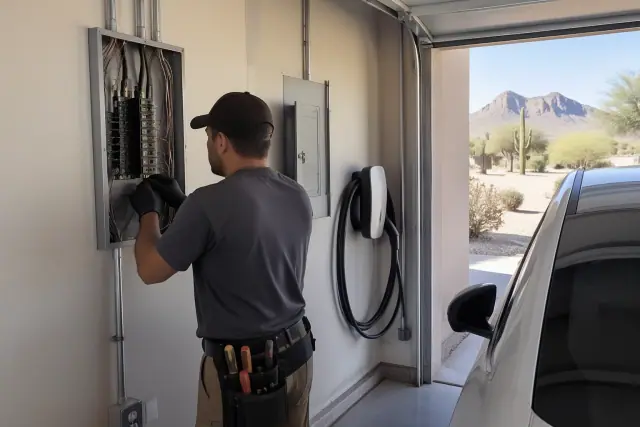
Panel condition and existing household loads determine whether the proposed charger fits the service. A load calculation checks capacity before equipment selection.
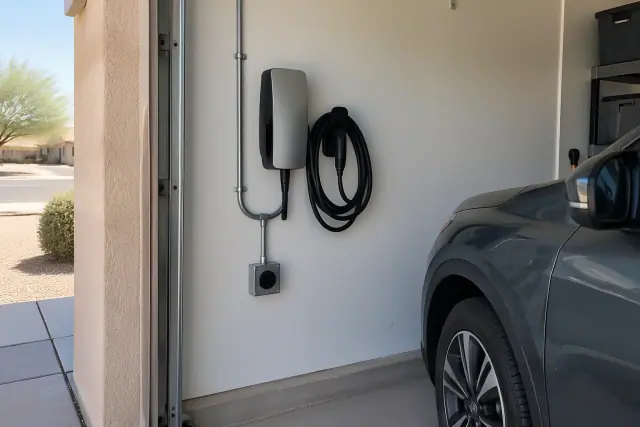
A compatible plug-in charger offers flexibility for future replacement. Hardwiring removes the plug-and-outlet connection but requires electrical work when the unit changes.
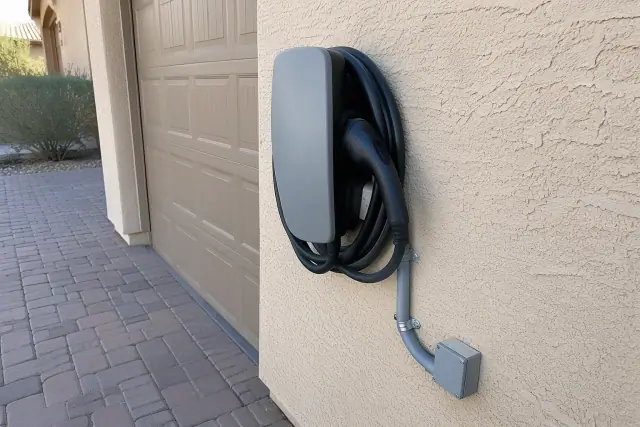
Outdoor mounting needs equipment suited to Arizona heat and monsoon moisture. Charger placement should also let the cable reach the vehicle's charge port without strain.
Straightforward Level 2 work with an existing 200A panel typically costs $400-$1,200 for labor, breaker, and wiring. Projects involving panel upgrades, detached-garage trenching, or long conduit runs can reach $1,500-$3,000 or more.
Mesa panel upgrades commonly move a home from 100A to 200A service and typically cost $1,800-$4,500. Scope depends on panel size, service-entrance conductors, and any utility coordination for meter work.
A standard residential installation with an existing 200A panel typically takes 3-6 hours. Panel upgrades, trenching, or long conduit runs can extend the work to 1-2 days; confirm permit and inspection scheduling separately.
Do not assume a dryer outlet or an older charger circuit can support a new unit. Have an electrician check the circuit rating, conductor size, grounding, and connection condition before reuse or a higher-amperage replacement.
| Charger's continuous draw | Branch-circuit breaker | What to confirm before installation |
|---|---|---|
| 32A | 40A | Confirm that the selected charging current fits the home's load calculation. |
| 40A | 50A | For a plug-in unit, confirm NEMA 14-50 compatibility, receptacle suitability, and required GFCI protection. |
| 48A | 60A | Plan the hardwired connection and verify conductor sizing against the equipment instructions and installation conditions. |
The 125% continuous-load relationship applies to these typical residential configurations. Breaker size does not establish available service capacity or wire size by itself; grounding, permits, and inspection remain part of the project.
Level 2 charging at home uses a 240V circuit designed for a continuous load. Charging for three hours or more makes circuit sizing especially important: the breaker rating is higher than the charger's operating current. A NEMA 14-50 installation typically uses a 50A breaker with 6 AWG copper conductors, but the electrician must confirm conductor ampacity, temperature ratings, wiring method, and the charger's instructions rather than choosing wire by gauge alone. Grounding follows NEC Article 250, and GFCI protection must match the circuit and equipment requirements. A hardwired unit connects directly to the electrical supply, removing the receptacle connection and its potential wear points.
A 1970s home in the Fiesta District may need a different electrical scope from newer construction near Eastmark; panel age or the neighborhood alone does not establish capacity. A detached garage adds routing and possible trenching, while a driveway mount adds weatherproofing. Apartment and multifamily projects need property-manager or landlord approval, any applicable HOA approval, shared conduit and submetering plans, and accessibility review. Fleet lots may need three-phase service, transformer-capacity review, and load management for simultaneous charging. DC fast charging brings substantially higher power demands and may require dedicated transformer infrastructure beyond a standard panel service.
Can I use an existing 240V outlet? Only after an electrician confirms that the receptacle, wiring, protection, and circuit capacity suit the charger's continuous load; an appliance outlet is not automatically suitable. How far from the building should the charger sit? There is no single residential setback that answers every installation. Manufacturer instructions and required clearances govern placement, and typical Level 2 cables are 18-25 feet long. Can I install it myself? Hiring a licensed electrician is the practical choice for a new circuit or hardwired unit because sizing, grounding, and permitting require electrical expertise. Can a replacement charger reuse the circuit? Often, if its amperage matches and the existing breaker, conductors, and connections meet the replacement unit's specifications.
Share your charger's rated amperage, the intended parking and mounting location, and any available panel information. A site assessment can establish the load calculation, circuit route, and permit scope before you approve installation.