Proudly serving Mesa, Gilbert, Chandler, Tempe, Queen Creek, Scottsdale & surrounding areasCall or Text 24/7: 602-559-1623
Aerial drone photo of residential neighborhoods and desert vegetation in Mesa, AZ.

EV Charger Repair & Troubleshooting in Mesa, AZ for Charging Failures & Tripped Breakers

Mesa EV Chargers provides EV charger repair and troubleshooting for homes, businesses, and multifamily properties in Mesa, AZ. We diagnose charging failures, repair cables and connectors, and check the electrical supply feeding your equipment. Our services also include Tesla Wall Connector installation, NEMA 14-50 outlets, and dedicated charging circuits. When a repair calls for a larger change, we handle panel upgrades and replacement chargers.

Mesa heat, dust, and monsoon grit can wear down charging equipment and interrupt your daily routine. Our electricians inspect the charger, test its power supply, and check communication with the vehicle before recommending repairs. We use insulation testing, load verification, and firmware diagnostics to narrow down the fault. You receive an explanation of the findings and the repair price before work begins.

Our electricians hold Arizona Registrar of Contractor licensing and follow NEC Article 625 alongside Mesa's local electrical amendments. We coordinate required permits and inspections through the Mesa Building Safety Division.

Mesa EV Chargers provides EV charger repair and troubleshooting in Mesa, Gilbert, Chandler, Tempe, Scottsdale, and Queen Creek.

★ ★ ★ ★ ★4.9/5 Customer Rating · 19 Years of Electrical Experience · 2,000+ Charging Projects Completed · Licensed, Bonded & Insured · Serving Homes, Fleets & Businesses

EV Charger Repair Options & Benefits

What Does EV Charger Troubleshooting Cover?

An EV charging failure can start in the property's electrical supply, the charging unit, or the vehicle's onboard charging module. Troubleshooting separates those possibilities so a working charger is not replaced because of a wiring or vehicle-setting issue.

We begin with the housing, cable, and connector, then check voltage and continuity at the panel, outlet or junction box, and charger. Testing under load helps uncover faults that appear only after current flows and components warm up.

Repair may involve cleaning a connector, correcting a wiring connection, updating firmware, or replacing damaged hardware. Failed control boards or internal relays sometimes need manufacturer-authorized parts; we explain that requirement before recommending the next step.

Why Diagnose Before Replacing a Charger?

A clear diagnosis connects the symptom to the part or setting causing it. That helps you understand whether the charger needs a small repair, electrical work, or replacement.

  • Identify supply faults before replacing working equipment
  • Check charging settings against the vehicle's acceptance limit
  • Locate heat damage in cables and connectors
  • Test pilot signals when power is present but charging will not start
  • Check firmware before condemning internal hardware
  • Review panel capacity before adding charging load
  • Understand parts requirements before scheduling further work
  • Receive diagnostic findings and pricing before repairs
Repair and Electrical Support

EV Charger Repair and Installation Services

Some charging faults need attention at the connector; others trace back to the original circuit or panel. We repair existing charging equipment and provide the electrical installation work needed when the diagnosis points beyond the unit.

No-Charge and Intermittent Fault Diagnosis

Multimeter and diagnostic test lead on a workbench during EV charger repair in Mesa, AZ.

We test chargers that refuse to start, stop mid-session, or display persistent fault lights. Voltage checks, continuity testing, and pilot-signal testing help distinguish an electrical supply failure from a charger or vehicle communication problem.

Request Estimate

Tesla Wall Connector Installation

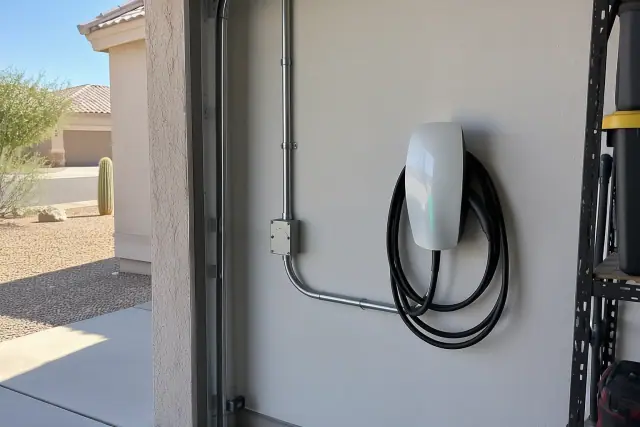
Tesla Wall Connector installed on a garage drywall in Mesa, AZ.

We install Gen 3 Tesla Wall Connectors with dedicated circuits matched to their configurable output and the vehicle's charging capacity. For a planned 48-amp output, we verify the circuit design and available panel capacity before quoting. Mounting height, cable reach, and a covered garage or carport location also guide placement.

Request Estimate

NEMA 14-50 Outlet Installation

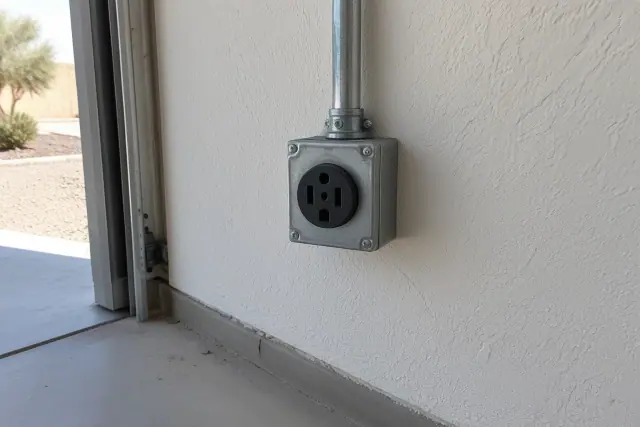
NEMA 14-50 EV charger outlet installation in Mesa, AZ, showing conduit and a metal junction box on a drywalled wall.

We install dedicated 50-amp, 240-volt NEMA 14-50 circuits for compatible portable charging equipment. Our design considers run length, voltage drop, and equipment grounding under NEC Table 250.122. We typically use 6 AWG copper for this circuit, with conductor selection checked against the actual installation conditions.

Request Estimate

Smart Charger Firmware Diagnostics

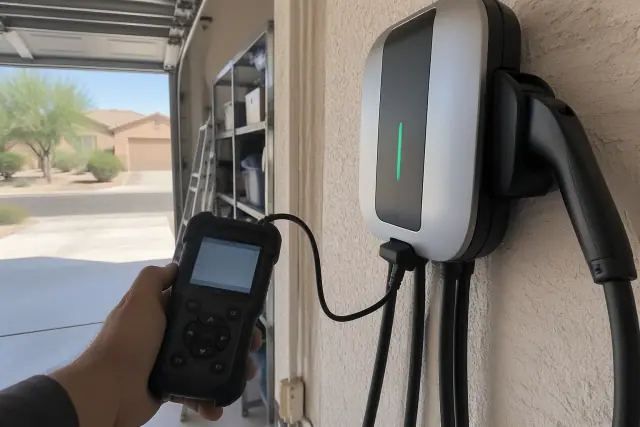
Technician performing EV charger firmware diagnostics inside a garage in Mesa, AZ.

Outdated firmware can interfere with scheduling, network connectivity, and charge-rate negotiation. We check Tesla, ChargePoint, and other networked units through the manufacturer's app or local interface, applying available updates before deciding whether hardware needs replacement.

Request Estimate

Panel Upgrades and Dedicated Circuits

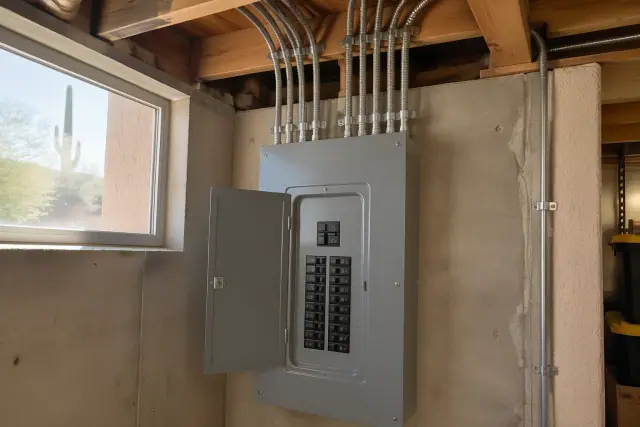
Electrical panel upgrade and EV charger repair in a Mesa, AZ basement utility area.

We assess the main service alongside HVAC, pool pumps, electric ranges, and the proposed charging load using NEC Article 220 load calculations. Some properties with 100- or 125-amp panels need a 200-amp upgrade; the calculation determines whether yours does. Dedicated circuit installation addresses charging loads that should not share outlets or lighting.

Request Estimate

Charging Cable and Connector Repair

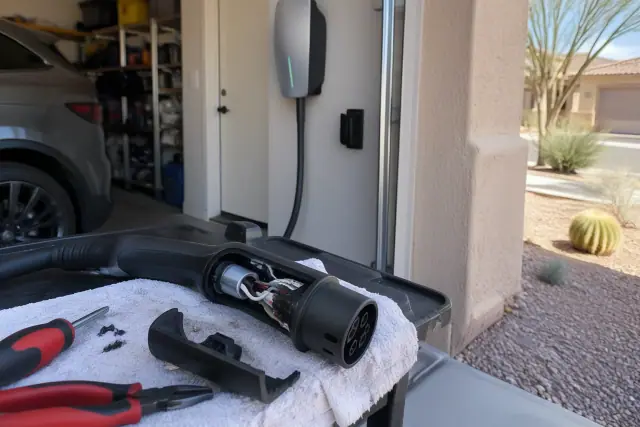
Technician repairing an EV charger cable in a residential garage in Mesa, AZ.

We inspect cable jacketing, connector pins, and the connector head for cracks, corrosion, and heat discoloration. Cleaning or connector replacement can resolve intermittent contact problems, including Tesla cable faults. Damaged insulation or exposed conductors mean the cable must be taken out of service.

Request Estimate
Equipment and Property Types

Charging Setups We Service

The right diagnostic approach depends on how the charger connects, how the vehicle accepts power, and how the property uses electricity. We work with residential Level 2 equipment, hardwired commercial chargers, and shared multifamily charging stations.

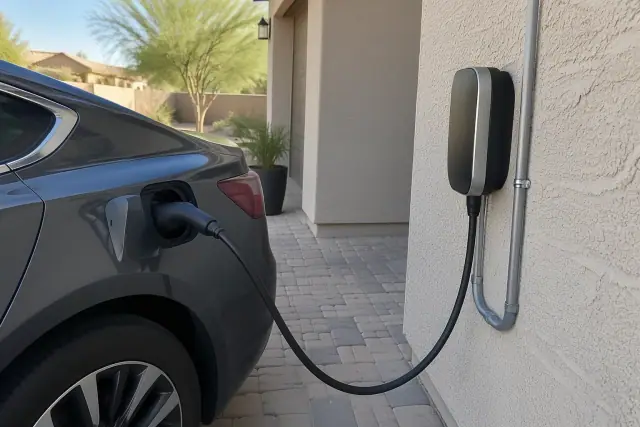
EV charger repair and troubleshooting on a stucco wall at a home in Mesa, AZ.

Residential Level 2 Charging

Home charging should fit both your daily driving and your electrical capacity. Residential Level 2 installations typically use dedicated 240V circuits rated from 40 to 60 amps, with the final design matched to the selected charger.

  • Garage and carport placement based on cable reach
  • Vehicle charging limits checked before setting output
  • Load calculations that include existing household appliances
  • Voltage-drop review for longer garage circuit runs
  • Panel assessment for older 100-amp home services
Request Estimate
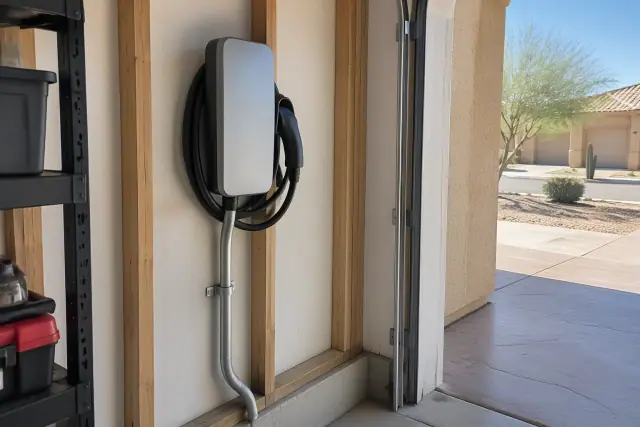
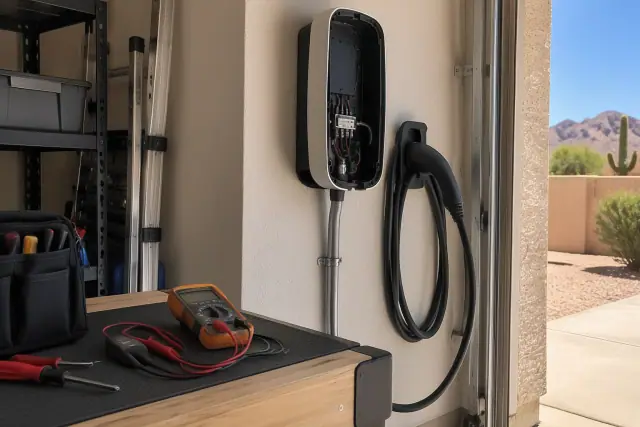
Hardwired EV charging equipment mounted on a garage wall in Mesa, AZ, during troubleshooting.

Hardwired Charging Equipment

A hardwired charger removes the receptacle as a connection point, but faults can still develop at the breaker, junction box, or internal electronics. We check those connections and the unit's operating condition before deciding which component needs attention.

  • Dedicated circuit review under NEC 625.40
  • Breaker and wiring-terminal inspection
  • Voltage testing at the charger
  • Contactor and control-board diagnosis
  • Required permits and inspection coordination for installation work
Request Estimate
EV chargers with exposed conduit and hardware in an employee parking lot in Mesa, AZ.

Networked and Vehicle-Specific Chargers

Smart chargers depend on software settings as well as electrical connections. We check whether scheduling, firmware, the network connection, or a vehicle-specific charging limit explains the reported behavior.

  • Tesla and ChargePoint firmware checks
  • Manufacturer-app or local-interface diagnostics
  • Charge scheduling review
  • SAE J1772 or Tesla pilot-signal testing as applicable
  • Vehicle onboard-charger settings verification
Request Estimate
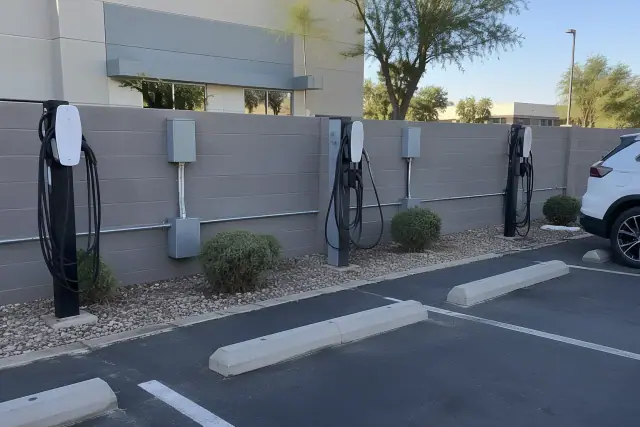
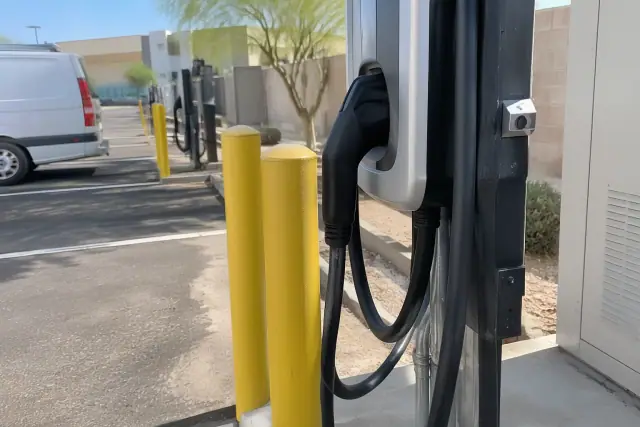
EV charger repair and troubleshooting in an asphalt parking bay in Mesa, AZ.

Commercial and Fleet Charging

Fleet charging plans depend on vehicle turnaround schedules and the property's utility feed. We evaluate 208V or three-phase service where applicable, including feeds from Salt River Project or Arizona Public Service; higher-output commercial equipment may call for circuits up to 100 amps.

  • Available service capacity assessment
  • Station placement around fleet operations
  • Multiple-port load balancing
  • Load testing for charging interruptions
  • Infrastructure planning for the selected equipment
Request Estimate
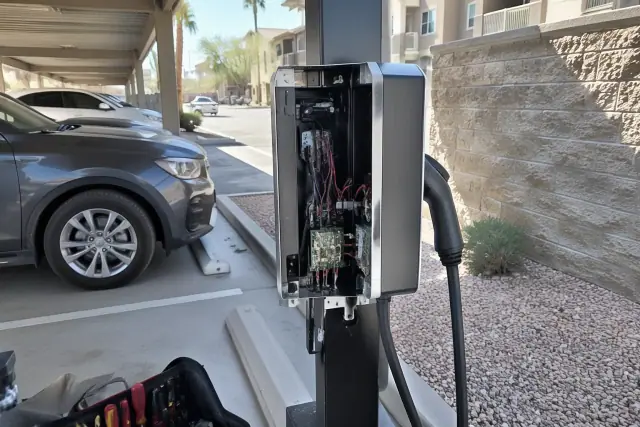
EV charger repair at an apartment carport with a split-face block wall in Mesa, AZ.

Apartment and Multifamily Charging

Shared parking introduces electrical and coordination requirements beyond a single garage installation. We plan apartment charging around submetering, property management or HOA coordination, and conduit routes that leave room for future expansion.

  • Shared parking conduit planning
  • Submetering requirements review
  • HOA and property management coordination
  • Dynamic sharing of available charging amperage
  • Expansion planning for additional charging ports
Request Estimate
Repair or Replacement

Choosing the Right Repair Approach

Equipment age matters alongside the fault and the availability of parts. Charging performance can begin declining around the 5 to 7 year mark, while commercial chargers have a typical service life of around a decade. We weigh the condition of the cable, electronics, and electrical supply against replacement cost, then explain which work addresses the actual problem.

Testing Beyond the Fault Light

A fault light does not identify the failed component by itself. We use megohmmeter insulation testing, load bank verification, and firmware diagnostics to evaluate the charger and its electrical supply before recommending parts.

Arizona Heat and Dust Awareness

Ambient temperatures above 115°F for weeks and pavement temperatures above 150 degrees put local charging equipment under prolonged heat stress. We account for sun exposure, dust, and monsoon conditions when inspecting housings, internal relays, and cable insulation.

Clear Findings Before Repair Work

We explain whether the fault is in the supply, charger, or vehicle and quote the repair before starting. If a main board or relay needs manufacturer-authorized parts, you receive that information upfront along with a realistic timeline.

Common Charging Faults

Why Choose Us for EV Charger Troubleshooting?

Our repair approach combines electrical testing with attention to the conditions that caused the failure. We consider applicable UL 2594 and UL 2202 equipment standards when evaluating components, and we check the original installation as well as the charger. The symptoms below help guide the inspection.

Request a Charger Assessment

Charging Stops in Direct Sun

A south-facing charger exposed to direct Arizona sun for eight months a year faces prolonged stress on relays, housings, and insulation. We check for heat-related damage and measure operation under load, since a unit can appear normal when cool.

The Breaker Trips During Charging

Repeated trips can point to wiring problems, a worn breaker, inadequate circuit sizing, or a fault in the charging equipment. We review the connected load and protective devices instead of assuming that a larger breaker will solve the problem.

The Connector Becomes Hot

Loose connections can create resistance heating after repeated thermal cycling, even when a charger worked normally for two years. We inspect outlet connections and connector contact surfaces for poor contact, discoloration, and damage.

Power Is Present but Charging Will Not Start

A charger can have power at the outlet and still fail to negotiate a charging session. We test communication with the vehicle and inspect for corroded pins, bent connector prongs, or dust-storm debris that prevents a sound connection.

Fault Codes or Dropped Sessions

Firmware and network problems can resemble hardware failure, causing sessions to stall or fault messages to recur. We review the manufacturer's interface and available updates before attributing the symptom to an internal control board.

Cracked or Worn Charging Cables

UV exposure and hot surfaces can wear cable jacketing and leave insulation cracked near the connector. We assess exposed conductors and heat damage, remove damaged cables from service, and determine whether a cable assembly or full charger replacement is needed.

From Symptom to Solution

Our EV Charger Diagnostic Process

We follow the fault from the visible symptom through the electrical supply, charger, and vehicle settings. Each step narrows the repair scope so you understand the recommended work and any parts or inspection requirements.

01.

Review the Charging Symptoms

We discuss error codes, charging interruptions, breaker trips, and whether the unit has ever charged reliably. The symptom history helps determine what needs close inspection during the diagnostic visit.

02.

Inspect the Unit, Cable, and Connector

We look for cracked insulation, heat discoloration, damaged pins, and debris at connection points. This visual inspection identifies damaged equipment that needs to be taken out of service.

03.

Test the Electrical Supply Under Load

We test voltage and continuity at the panel, outlet or junction box, and charging unit. Measurements under load help reveal supply faults that are not apparent when the charger is idle.

04.

Check Vehicle Communication and Firmware

We test the pilot signal, review the vehicle's charging limits, and check the charger's firmware and network settings. Available manufacturer updates are considered before recommending electronic hardware replacement.

05.

Explain the Repair Scope and Price

We show you the diagnostic findings and provide a clear price before repair work. If the repair needs a manufacturer-specific board, relay, or other part, we explain the availability issue and expected timing.

06.

Complete Repairs and Verify Operation

We carry out the agreed repair and verify charging operation with appropriate testing. Where the work includes new circuits or hardwired installation, we coordinate required permits and inspection through Mesa Building Safety.

Get Your Charger Checked

Schedule EV Charger Troubleshooting

Call Mesa EV Chargers about a charger that will not start, repeatedly trips a breaker, or has developed a cable or connector fault. We will discuss the symptoms and help determine whether an on-site diagnostic visit is needed.

Charging Questions Answered

EV Charger Repair in Mesa: FAQs

Find answers about charging failures, repair costs, electrical capacity, and the differences between equipment types. These details can help you describe the problem when you call.

Discuss Your Charger

Slow charging, recurring error codes, failed session starts, and repeated breaker trips all warrant attention. Cracked cable insulation, a discolored connector, or buzzing from the unit also call for inspection. We can discuss the symptoms by phone and help determine whether an on-site diagnostic visit is needed.

The fault may be in the property's electrical supply, the charger's internal components, or the vehicle's onboard charging equipment. Loose connections, wiring that is unsuitable for the run, worn breakers, failed contactors, and heat-damaged boards are possible causes. We test these points separately to identify the source.

Yes, an available manufacturer update can sometimes resolve scheduling, communication, or false-fault problems. We check firmware as part of diagnosis before assuming the hardware has failed. A software update will not correct damaged wiring or a worn connector.

Cost depends on whether the visit involves diagnosis, connector cleaning, a firmware update, component repair, or full replacement. Breaker and dedicated-circuit work can involve more than a simple charger adjustment. We inspect the issue and provide findings and a clear repair price before starting work.

Hardwired equipment can develop faults at the breaker, junction-box connections, internal contactor, or control board. Thermal cycling may loosen connections even though there is no receptacle involved. We check the supply and terminals before moving to the charger's electronics.

A standard 120V Level 1 setup adds roughly 3-5 miles of range per hour, while 240V Level 2 charging adds 20-40 miles per hour depending on amperage. DC fast charging uses higher-voltage, specialized equipment generally associated with public and commercial networks. Mesa EV Chargers focuses on Level 2 residential, commercial, and multifamily installations and their supporting electrical work.

That depends on the charger's continuous load and your property's available electrical capacity. Our breaker sizing follows NEC 625.41, including the 125% continuous-load requirement; a 40-amp continuous charging load calls for a minimum 50-amp breaker. Some Mesa homes built in the 1990s and early 2000s have 100-amp services already near capacity, so we calculate the existing load before recommending an upgrade.

Most single-unit residential repairs are completed in one visit after diagnosis, often within a couple of hours depending on parts needs. Manufacturer-specific components can extend that timeline when they must be sourced. Multiple-station repairs and panel-level work can take longer, and we explain the expected schedule after the initial diagnostic.

Yes, sustained heat and UV exposure can stress housings, internal components, and cable insulation. Dust and monsoon grit can interfere with connector contact. We inspect for those effects and consider covered placement when planning a replacement or new installation.

The decision depends on the failed component, parts availability, and the condition of the remaining equipment. Replacement may become more practical when a unit approaches or passes the roughly 10-year service-life mark and repair is no longer economical. We match a replacement's amperage and connector type to your vehicle and anticipated charging needs.

New circuits and hardwired charger installations require an electrical permit in Mesa. We handle the application through the Mesa Building Safety Division and coordinate the required inspection. For repair work, we explain which permit or inspection requirements apply to the actual scope.

Yes, we work with commercial, fleet, and multifamily charging equipment. We assess available service capacity, shared parking conduit routes, and property management or HOA coordination. Load management can dynamically share available amperage across ports, with expansion considered in the design.

Mesa EV Chargers provides repair, installation, and troubleshooting across Mesa, Gilbert, Chandler, Tempe, Scottsdale, and Queen Creek. We serve residential, commercial, and multifamily charging needs throughout these East Valley service areas.