Separate Installation from Equipment
The charger on the wall is only part of the purchase. Compare electrical labor, breaker and wiring materials, mounting, and permit costs separately from the charger unit so each quote covers the same work.
Mesa EV Chargers assesses your electrical panel and parking location before quoting, because the cost depends on the work your home needs. Most Mesa homeowners pay $400 to $1,800 for professional Level 2 installation, with the charger unit priced separately. Knowing what the quote includes helps you compare an outlet installation, a hardwired connection, and any necessary panel work.
The charger on the wall is only part of the purchase. Compare electrical labor, breaker and wiring materials, mounting, and permit costs separately from the charger unit so each quote covers the same work.
A garage-adjacent panel may need a 10-foot wire run. Detached garages or side-yard parking can require 50-100 feet of conduit, attic routing, or trenching, increasing materials and labor.
Have the installer assess panel capacity, measure the route, and confirm the charger connection before setting a price. A written scope should explain whether panel work, permits, and the charger itself are included.
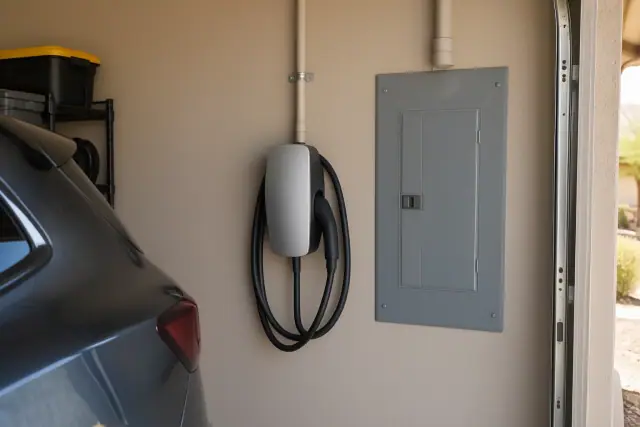
A nearby panel can shorten the cable run and simplify installation. The installer still needs to check available electrical capacity before quoting.
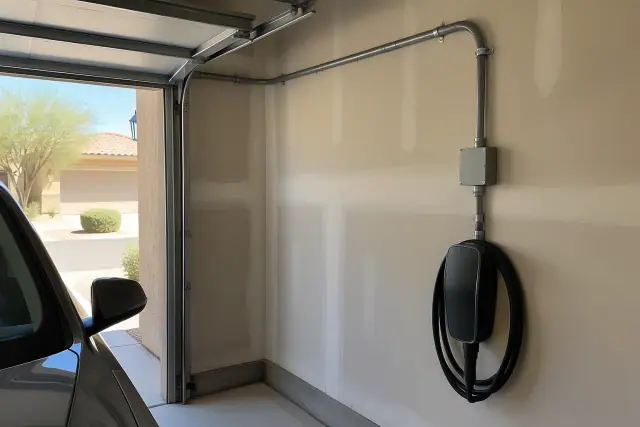
A detached garage can require a longer route and excavation. Identifying that route early helps explain why two installations may have very different prices.
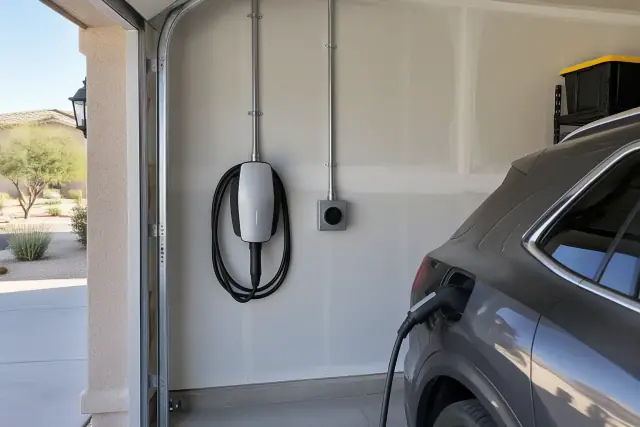
A hardwired charger connects directly to its dedicated circuit; a compatible plug-in charger uses an outlet. Compare the required wiring and connection work before comparing prices.
A 100-amp service supporting HVAC, a pool pump, and an electric range may need more capacity for a 40-50 amp EV circuit. A load calculation determines whether an upgrade is necessary.
Basic Level 2 units start around $300, while smart models with WiFi, app scheduling, and demand-response features can cost $900 or more. Compare those features separately from installation labor.
Residential installation typically takes 3 to 8 hours. Panel upgrades or trenching can add a second day; multi-port commercial projects typically take one to two weeks including permit approval.
Replacing an older 30-amp charger with a 48-amp unit requires checking the existing wire gauge and circuit capacity. Do not assume an existing circuit can support a higher-output charger.
| Installation or Service | Typical Cost | What to Review |
|---|---|---|
| NEMA 14-50 outlet installation | $1,400-$1,900 | Breaker, wire, and outlet; charger purchased separately. Wire-run length and panel type affect the total. |
| Hardwired Level 2 installation | $700-$2,000 | Dedicated connection and installation work; confirm charger equipment and any panel upgrade separately. |
| Panel upgrade from 100 amps to 200 amps | $1,200-$3,500 | Additional service capacity when needed; utility service-drop work can affect the price. |
| Charger replacement on existing wiring | $300-$700 | Labor and equipment for replacement using a suitable existing circuit; capacity must be checked. |
| Charger diagnostic visit | $100-$250 | Troubleshooting breaker trips, loose connections, or smart-charger faults; confirm any repair charges. |
| Commercial Level 2 installation | $2,500-$6,000 per port | Retail, hotel, or workplace charging; parking-lot trenching and service upgrades can increase cost. |
| Multifamily installation | $1,500-$4,000 per port | Shared stations or dedicated chargers billed to individual units; layout and future expansion affect scope. |
| Commercial DC fast charging | $20,000-$100,000+ per station | Three-phase power and substantial electrical infrastructure; a different scope from residential Level 2 charging. |
These scopes are not interchangeable. Confirm whether each quote includes equipment, permits, and panel work before comparing totals. Fleet projects often start around $5,000 per port with utility coordination and load management; multifamily sites can begin with 2-4 ports and plan for later expansion.
A complete installation quote separates the electrical work, charger mounting and connection, and permit or inspection fees. Level 1 charging uses a 120V household outlet and often needs no new installation if the existing outlet is suitable. Level 2 uses 240V and typically adds 20-40 miles of range per charging hour, depending on the vehicle and equipment. Its broader installation range is $400 to $2,000, with the charger purchased separately; residential work across Arizona generally runs $500 to $2,000. These ranges describe different scopes, so compare the specified work before treating a lower number as a better offer.
Homes built before the 1990s in areas such as Dobson Ranch or Alta Mesa may have 100-amp service, while newer homes near Eastmark and Signal Butte Road may have 200-amp service. The panel rating alone does not establish available capacity: existing household loads matter. Finished-wall routing, attics, and slab trenching can push installation to $1,800-$2,500. For otherwise equivalent work, a hardwired connection can add $200-$400 in labor compared with an outlet connection. Mesa summer heat also makes wire insulation and routing relevant to the installation assessment.
What should a straightforward installation cost? With an existing 200-amp panel and parking within 25 feet, expect $500 to $1,500 for the outlet or hardwire connection, with the charger unit priced separately. How much is electrician labor? Phoenix metro labor typically runs $85 to $150 per hour; a standard circuit and outlet installation takes 3 to 6 labor hours. Straightforward jobs commonly carry $300 to $900 in labor before materials, permits, or panel work. Can I claim the federal charger tax credit? IRS Section 30C does not cover equipment placed in service after June 30, 2026. Qualifying earlier residential installations could receive 30% of eligible costs, up to $1,000 per charging port, subject to census-tract and other eligibility rules. Keep the itemized invoice and ask your tax preparer about Form 8911; confirm any current utility rebate before subtracting it from your budget.
Share your vehicle and charger plans, parking location, and what you know about the electrical panel. Mesa EV Chargers can assess the panel, measure the wiring route, and provide a firm quote before work begins.