Choose the Charging Level
Commercial Level 2 units commonly draw 30-80 amps. DC fast chargers in the 150-350 kW range often need three-phase service and a dedicated transformer, putting them in a different infrastructure category.
Mesa EV Chargers quotes commercial installations in Mesa after checking panel capacity and the route to your parking spaces, because electrical infrastructure can cost more than the charger itself. Level 2 installations typically run $3,500-$15,000 per port. DC fast-charging equipment ranges from $80,000 to $250,000 or more per unit before site work and utility coordination.
Commercial Level 2 units commonly draw 30-80 amps. DC fast chargers in the 150-350 kW range often need three-phase service and a dedicated transformer, putting them in a different infrastructure category.
The route from the electrical room to the parking space affects conduit, conductor, and trenching work. Long underground runs or asphalt excavation can make a modest charger a much larger project.
A useful quote follows a panel load calculation and parking layout review. Confirm the charger, dedicated circuit, site work, and any service upgrade in the written scope before approving installation.
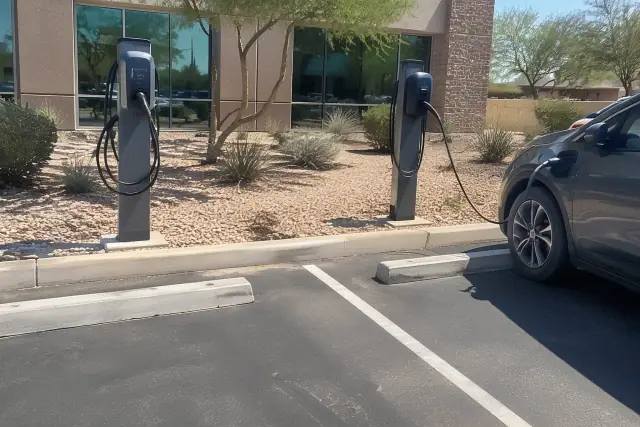
An office parking space near the electrical room helps illustrate a simpler Level 2 installation. Available panel capacity and the conduit route determine how much electrical work it needs.
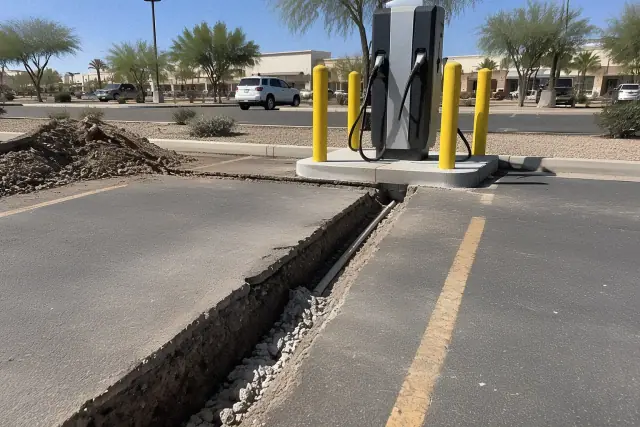
A trench across an existing parking lot shows why charger hardware is only part of the budget. The quote should account for excavation and the route of underground electrical work.
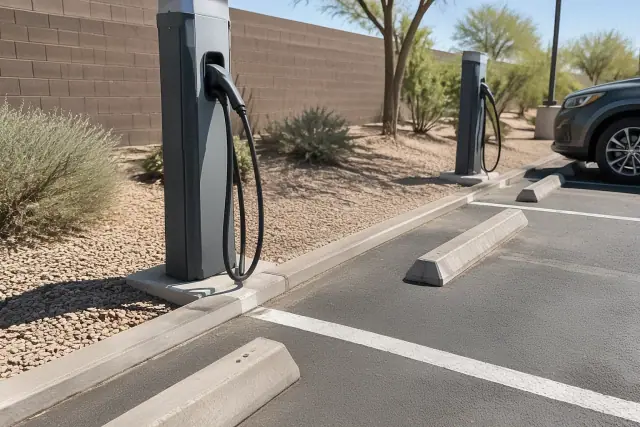
Reviewing the panel and proposed charging spaces together connects the electrical load calculation to the parking layout. This helps identify service upgrades and access requirements before quoting.
A straightforward Level 2 installation with enough panel capacity can often be completed in one to three days. Confirm permit timing separately from the installation work.
Larger installations involving trenching, utility coordination, or three-phase service typically take four to eight weeks once permits and utility scheduling are included.
An older 100- or 150-amp panel may need an upgrade to 200-400 amp service for multiple ports and the existing building load. The load calculation determines whether an upgrade is necessary.
Compare quotes for the same work: charging ports, circuits, trenching, bollards, striping, and accessible parking modifications. An equipment-only price does not describe a completed charging site.
| Project scope | Typical price range | What the range covers or depends on |
|---|---|---|
| Commercial Level 2 port | $3,500-$15,000 per port installed | Charger hardware and electrical labor; panel capacity, conduit distance, and trenching affect the final scope. |
| Single office Level 2 port | $4,500-$12,000 installed | An office charging installation; electrical room distance and available capacity influence the price. |
| DC fast charger (Level 3) | $80,000-$250,000+ per unit before site work and utility coordination | Power output drives equipment cost; confirm trenching, switchgear, transformer, and utility work separately. |
| Panel or service upgrade | $2,000-$8,000 when needed | Existing service size and the capacity required for charging and building loads determine the work. |
| NEMA 14-50 outlet installation | $1,200-$2,000 per outlet installation | Phoenix East Valley outlet work; run length, panel distance, and routing through stucco, block, or slab affect cost. |
The office-port range is a specific Level 2 installation scope. Panel upgrades and outlet work are separate scopes to check against your quote, not amounts to add automatically to every port.
An installed commercial charging price brings together the charger, electrical infrastructure, and parking lot work. A retail property along Power Road, a downtown Mesa office building, and a warehouse lot near the Fiesta District can require different conduit routes and parking changes. Hardwired installation costs depend on wire gauge, conduit type, and whether conductors run through exposed EMT conduit or finished walls. Desert heat also matters when selecting outdoor equipment and materials. Ask how the written scope handles City of Mesa Building Safety Division permit review, Salt River Project service coordination where needed, and accessible parking modifications such as access aisles and van-accessible spacing.
Fleet charging costs scale with vehicle count and site capacity, while multifamily properties may use shared Level 2 ports with usage metered per unit or parking space. Fleet programs report fuel savings of roughly $1,032 per vehicle annually, but savings depend on operating costs. A $120,000-$200,000 cumulative savings figure for a 20-vehicle fleet needs a defined time horizon before it can establish a payback period. Electricity rates, utility demand charges, and charging fees also belong in the operating budget; installation price alone cannot show the full financial outcome.
Do I need an electrical upgrade? A single Level 2 port may fit the existing service if the load calculation shows enough spare capacity; multiple ports or DC fast charging can require more infrastructure. What breaker size is needed? Many commercial Level 2 units use a 40-100 amp dedicated breaker; the NEC Article 625 continuous-load sizing relationship is 125% of charging current, or 80% circuit loading, so a 48-amp charger calls for a 60-amp breaker and appropriately sized conductors. What does charging cost afterward? The electricity tariff, demand charges, and any per-kWh fee set by the property determine ongoing cost. Can existing wiring reduce replacement costs? Reusable wiring and adequate panel capacity can make a replacement less involved than rebuilding the electrical supply.
Share your property type, planned charging spaces, and intended number of ports. Mesa EV Chargers offers a free quote that includes a panel load calculation, parking layout review, and written scope so you can compare the proposed work before installation.