Capacity Before Replacement
Roughly 70-80% of installations proceed without full panel replacement, while about 20% of homes need additional electrical work. Your available capacity determines the recommendation.
Mesa EV Chargers checks panel capacity in East Valley homes to determine whether an EV charger needs a panel upgrade. Most homeowners do not need a full replacement, but the answer depends on available amperage, existing household loads, and panel condition. Confirming those details before choosing a circuit helps avoid unnecessary panel work.
Roughly 70-80% of installations proceed without full panel replacement, while about 20% of homes need additional electrical work. Your available capacity determines the recommendation.
Air conditioning, water heating, the dryer, and pool equipment all draw from the same service. Empty breaker slots alone do not establish room for an EV charging load.
Have a licensed electrician document a load calculation under NEC 220. The assessment includes rated amperage, main breaker size, existing circuits, and panel condition.
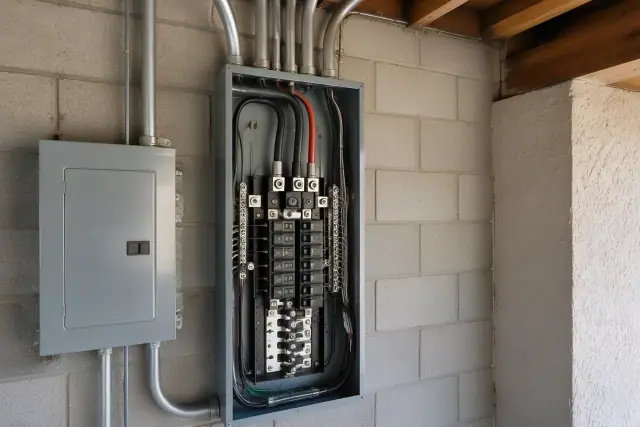
The panel rating and breaker inventory help an electrician evaluate the proposed EV circuit. Available slots and available amperage are separate checks.
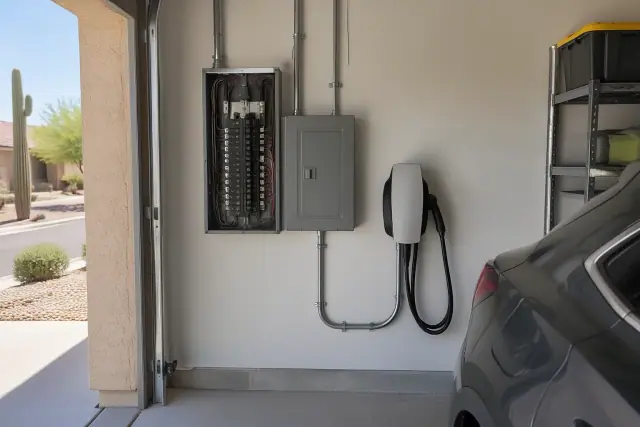
Load management reduces charging output as household demand rises. It can make an EV charger possible without a full service upgrade.
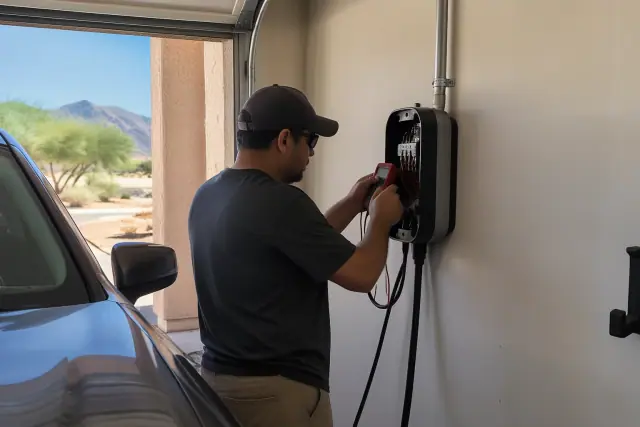
A dedicated NEMA 14-50 outlet or hardwired connection needs circuit sizing suited to continuous EV charging. The electrician checks the installation against NEC Article 625 and manufacturer requirements.
A 200 amp service commonly supports a dedicated 50 amp EV circuit. The load calculation still has to account for appliances and added subpanels before confirming capacity.
Central AC units can draw 30-50 amps continuously during peak heat. Dual AC units, pool equipment, spas, and workshop circuits can leave less headroom than the main-breaker rating suggests.
Panels older than 20-25 years, including those installed before the mid-1990s, deserve an evaluation before adding charging load. Frequent breaker trips, discoloration, or rust also warrant inspection.
A dryer receptacle may be a NEMA 14-30, but voltage alone does not establish EV suitability. Have its wiring, rating, and circuit arrangement evaluated for continuous charging before using it.
| Existing service or condition | Typical charging outlook | What to confirm |
|---|---|---|
| 100 amp service | Often needs load management or an upgrade. | Calculate existing appliance loads and compare remaining capacity with the proposed EV circuit. |
| 150 amp service | May support charging, depending on existing loads. | Account for summer AC demand, especially in homes with dual units. |
| 200 amp service | Usually supports a 40-50 amp EV circuit without a full upgrade. | Verify the load calculation, panel condition, and available breaker space. |
| Capacity available, but no open breaker slots | A small subpanel or suitable tandem breakers may address circuit space. | Have an electrician assess the panel configuration before choosing either option. |
| Deterioration, recurring trips, or a busbar below 150 amps | Needs evaluation before adding EV charging load. | Determine whether panel work, an upgrade, or load management addresses the actual limitation. |
Service size is a starting point. A documented load calculation and condition assessment determine whether the existing panel can support the proposed charger.
Sometimes. Load management shares available amperage between charging and existing household loads, while smart charging can reduce output during peak demand. If the issue is breaker space, an electrician may be able to use suitable tandem breakers or a small subpanel without changing the main service. These options address different limitations, so ask whether the recommendation solves a capacity, circuit-space, or condition problem. A deteriorating or undersized panel may still need replacement; a panel with sufficient capacity may need only a dedicated charging circuit.
Adding more charging points changes the load calculation. Multi-charger or fleet setups often require 400 amp service or subpanels, depending on whether vehicles charge sequentially or simultaneously. Commercial installations also involve demand calculations and possible 3-phase service considerations. Apartment and condo properties may use load management across dozens of units sharing one service. Include future charging needs in the assessment so the electrical plan accounts for expansion.
For cost, panel upgrades generally run $1,500 to $4,000 in the Mesa area; a 200 amp service upgrade typically costs $2,500 to $4,500 including permit fees. Charger installation without panel work ranges from $800 to $2,500, depending on wire run length and outlet type. Utility service-line coordination or a meter upgrade can change the scope. For timing, residential panel work usually takes one to two days on site, while utility coordination, permit approval, and City of Mesa inspection scheduling can extend the full timeline to one to two weeks. Confirm both the circuit-only and panel-work scope before approving an estimate.
Share your panel's age, major appliances, and planned charging setup. Mesa EV Chargers can assess the panel, document the load calculation, and handle permitting and installation so you can decide whether a dedicated circuit, load management, or an upgrade fits your property.