Match the breaker to charging current
For these Level 2 circuits, the breaker rating must be at least 125% of the continuous charging load. A 32-amp charger therefore needs a 40-amp circuit.
Mesa EV Chargers sizes home and commercial EV charging circuits in Mesa, Arizona, around the charger's configured current and the electrical panel's available capacity. Matching the breaker, wiring, and charging equipment keeps a long charging session within the circuit's limits.
For these Level 2 circuits, the breaker rating must be at least 125% of the continuous charging load. A 32-amp charger therefore needs a 40-amp circuit.
HVAC, pool equipment, and electric ranges already use part of the home's electrical capacity. Include those loads when assessing whether the panel can support the proposed EV circuit.
An adjustable charger's maximum setting must match its installed circuit. Have the installer configure and verify the permitted limit using the equipment manufacturer's instructions.
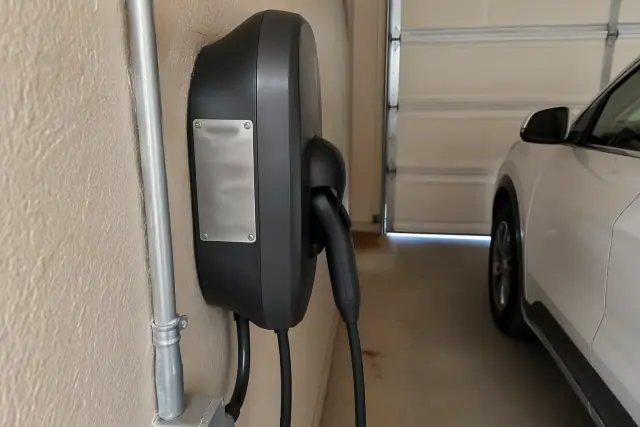
The nameplate identifies the equipment's rating; the approved installation setting establishes its charging limit. Both matter when selecting a breaker.
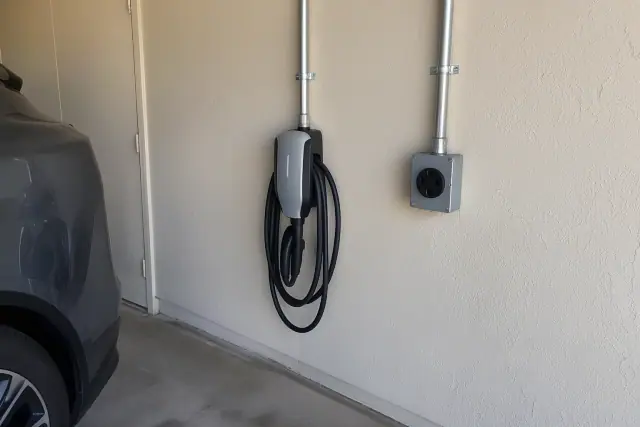
A receptacle connection and a hardwired connection have different limits. A 48-amp charging setup needs an appropriate hardwired circuit.
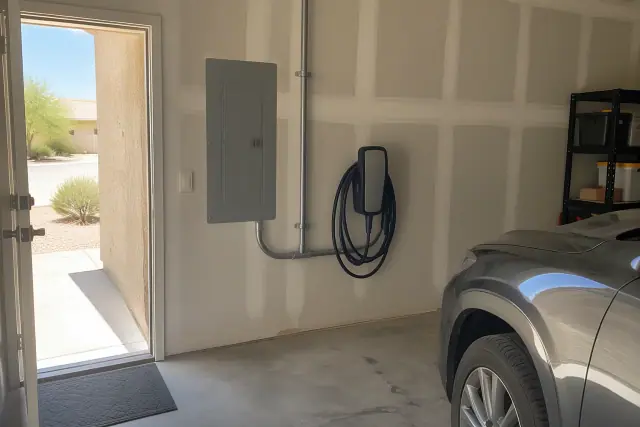
The panel and charger location help an electrician assess available capacity and the wiring route. Attic or exterior runs also bring heat exposure into the decision.
Some Mesa homes built in the 1970s through 1990s, including homes in Dobson Ranch and Fiesta District, have 100- or 125-amp panels. Their existing loads determine whether a new charging circuit fits.
When Mesa summer temperatures exceed 110°F, attic and sun-exposed wiring routes need particular attention. Ambient-temperature correction can require larger conductors than a basic wire-size comparison suggests.
Intermittent faults or corroded connectors call for diagnosis. For a charger more than seven to eight years old, compare repair and replacement options, especially when repair approaches half the price of a new unit.
Do not replace a 50-amp breaker with a 60-amp breaker just to stop tripping or increase charging speed. The conductors, equipment, and panel capacity must support the proposed load.
| Continuous EV charging current | Minimum circuit and breaker rating | What to confirm |
|---|---|---|
| 32 amps | 40 amps | The charging unit is rated or properly configured for this load; a larger breaker alone adds no charging speed. |
| 40 amps | 50 amps | A suitable NEMA 14-50 setup or hardwired charger, with conductors and panel capacity verified for the installation. |
| 48 amps | 60 amps | A suitable hardwired charger, with conductors and panel capacity verified for the higher continuous load. |
Before choosing: Have an electrician verify the equipment instructions, wiring, and load calculation. These pairings do not authorize changing an existing breaker without checking the complete circuit.
EV charging is treated as a continuous load under NEC Article 625; charging sessions can run for three hours or more. The circuit must support that sustained demand. At 240 volts, 40-amp charging delivers roughly 9.6 kW, while 48-amp charging delivers roughly 11.5 kW. That increase is useful only when the charging equipment and vehicle can accept it. Putting a 32-amp charger on a larger circuit does not increase its output. Some 50-amp installations use 8 AWG copper and some 60-amp installations use 6 AWG copper, but neither gauge is a universal specification: conductor insulation, terminal ratings, installation method, and heat determine the final selection.
When the load calculation shows insufficient capacity, options include a lower approved charging setting, suitable load management, or a panel upgrade. An upgrade may involve moving to 200-amp service. Typical EV charger panel upgrades in Mesa cost roughly $1,800 to $3,500, depending on a straightforward panel replacement versus a service upgrade requiring utility coordination. Permits and inspections go through the City of Mesa. A standard dedicated circuit installation usually takes one day; a panel upgrade involving utility coordination can take one to two weeks, depending on permit and inspection scheduling.
Can a charger capable of 48 amps use a 50-amp circuit? Yes, if its manufacturer permits an installer-configured limit of 40 amps or less and the circuit is suitable; it cannot operate at 48 amps on that circuit. Can two EV chargers share capacity? Two-car garages may need separate dedicated circuits or an approved load-management arrangement. Have an electrician verify the equipment and circuit design before adding a second unit. Does the same comparison cover commercial or apartment charging? It helps with individual Level 2 units, but multiple stations require a property-wide load calculation. Larger fleet systems can exceed 48 amps per unit and may require three-phase service or dedicated transformers, depending on the equipment and simultaneous demand.
Share your charger model, intended charging location, and any known panel information with Mesa EV Chargers. An installation assessment can confirm the current setting, wiring requirements, and whether the proposed circuit needs additional panel capacity.