Proudly serving Mesa, Gilbert, Chandler, Tempe, Queen Creek, Scottsdale & surrounding areasCall or Text 24/7: 602-559-1623
Guides

Can a Normal Electrician Install an EV Charger in Mesa, AZ?

Mesa EV Chargers helps Mesa homeowners check whether an electrician is prepared for an EV charger installation. Yes, a general electrician can do the work when the contractor holds the appropriate electrical license and understands the equipment. Before accepting a quote, confirm that it covers panel capacity, the charging circuit, manufacturer instructions, and the permit and inspection process.

Quick Summary

  • A general electrician can install a home EV charger; confirm the appropriate Arizona electrical contractor license and experience with Level 2 equipment.
  • Ask for a load calculation before choosing charging amperage. Available breaker spaces alone do not establish panel capacity.
  • A new charging circuit in Mesa needs a permit and inspection. Confirm who handles both before work starts.
  • Compare the complete scope: circuit sizing, grounding, conduit route, charger setup, and final testing all matter.

What Makes an Electrician EV Ready?

Electrical License and EV Experience

Look for an appropriate Arizona Registrar of Contractors electrical license, then ask about comparable charger installations. The useful distinction is whether the electrician can explain load calculations and equipment setup, including the manufacturer requirements for your charger.

Panel Capacity and Charging Load

Home chargers commonly draw 16 to 48 amps continuously. The electrician should establish available panel capacity, choose a suitable charging setting, and match the circuit to that load before recommending equipment or a panel upgrade.

Permit, Inspection, and Testing

Ask who will file the City of Mesa permit, arrange inspection, and test the finished installation. The handoff should include a walkthrough of the charging settings so you understand the output the circuit and vehicle can support.

EV Installation Details to Compare

Electrician Reviewing an EV Charger Electrical Panel

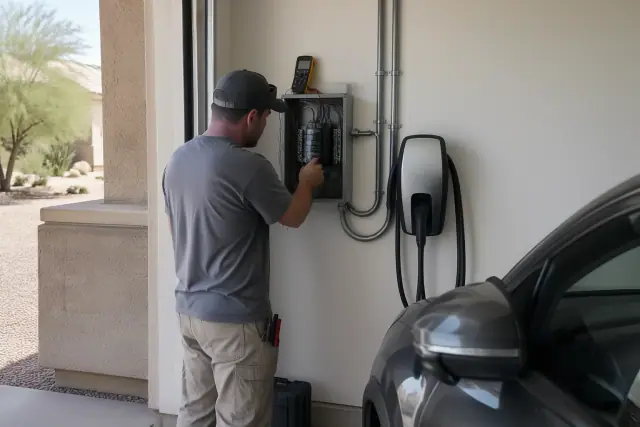
Electrician reviewing an EV charger electrical panel on a drywalled interior wall in Mesa, AZ.

The panel review checks the main breaker rating, existing loads, and room for the charging circuit. A load calculation determines whether the proposed charger fits the available capacity.

Hardwired EV Charger Beside a NEMA 14-50 Outlet

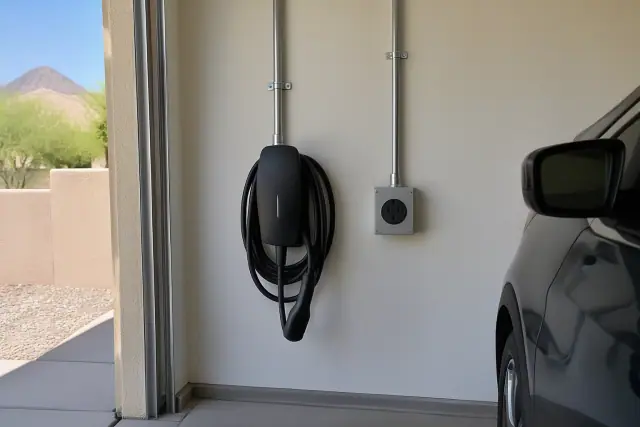
Hardwired EV charger and NEMA 14-50 outlet on a drywall wall in Mesa, AZ.

A hardwired wall unit connects directly to the circuit; a compatible plug-in unit uses the receptacle. Ask the electrician to explain which arrangement suits the equipment and your daily charging needs.

EV Charger Conduit Route Across a Garage Wall

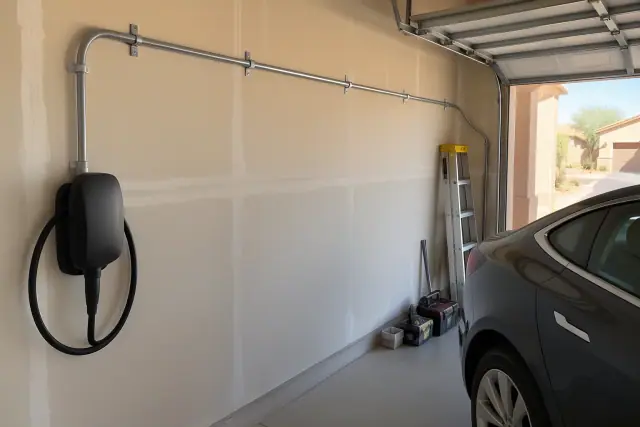
EV charger conduit route across a garage wall during residential installation in Mesa, AZ.

The route from the panel to the parking space affects materials and labor. Longer runs, stucco or block walls, and trenching can make the work more involved than a charger mounted near the panel.

Before You Accept the Quote

Confirm Available Panel Capacity

Older 100-amp or 125-amp panels may need an upgrade, while a 200-amp panel still needs a capacity review. Homes ranging from 1970s ranch properties to newer Eastmark builds have different existing loads and wiring conditions.

Match the Circuit to Charging Output

For typical dedicated Level 2 circuits, the breaker is sized at 125% of the continuous charging load: 32 amps pairs with a 40-amp breaker, 40 with 50, and 48 with 60. The electrician must also verify conductor sizing and equipment requirements.

Investigate Trips and Slow Charging

Recurring breaker or GFCI trips and unexpectedly slow charging need diagnosis. Possible causes include loose connections, circuit sizing, charger settings, or firmware faults; an electrician should establish the cause before recommending replacement.

Avoid Shortcuts in the Quote

Do not approve a charging circuit without a clear load assessment and permit plan. Ask the installer to explain the selected wire, breaker, grounding, and charging setting; a larger breaker alone does not establish that existing wiring is suitable.

EV Installer Comparison Checklist

Ask the ElectricianA Useful Answer CoversClarify Before Approval
Have you installed comparable EV chargers?Relevant electrical licensing, similar equipment, and familiarity with manufacturer setup requirements.General electrical experience without an explanation of EV charging work.
Can this panel support the proposed charger?A load calculation, review of existing loads, and a charging setting supported by the available capacity.A recommendation based only on an empty breaker space or the panel rating.
How will you size and route the circuit?Continuous charging load, matching breaker and conductors, grounding, and the route to the parking space.An amperage recommendation without checking wiring or installation distance.
Who handles the permit and inspection?A clear plan for the City of Mesa permit and required inspection.A quote that leaves permit responsibility or inspection scheduling unclear.
What happens before the job is complete?Final testing, confirmation of charging settings, and a walkthrough of the equipment.Installation scope that ends at mounting and connection without testing.

What a Qualified Installer Should Explain

A capable general electrician should be able to describe the same sequence as an experienced EV installer: evaluate the site and calculate the load, obtain the permit, install the circuit, mount and connect the charger, then complete inspection and testing. Residential Level 2 equipment uses a dedicated 240-volt circuit rather than a standard 120-volt outlet. Ask how the design follows National Electrical Code Article 625, the grounding requirements, and the equipment instructions. Terminal torque, conduit fill, and any required GFCI protection depend on the installation details. If the electrician cannot explain those choices, seek someone with experience on comparable EV charging projects.

What Changes Installation Cost and Scope

A straightforward residential Level 2 installation in Mesa typically costs $500-$1,800, depending on the connection type and circuit work. A NEMA 14-50 outlet generally costs $500-$1,200. A wall connector near the main panel typically runs $600-$1,200; longer conduit runs, stucco penetration, or capacity complications can push that toward $1,500-$1,800. A separate upgrade from a 100-amp to a 200-amp panel typically costs $1,500-$4,000, depending on utility coordination. Ask for a fixed quote after the site evaluation and confirm whether any panel work is included. Apartments and commercial properties add metering, shared routing, and utility considerations. Commercial installations often range from $3,000-$15,000 per station, depending on transformer capacity, trenching, and networked equipment. Those projects call for experience beyond a single garage installation.

Common Follow-Up Questions

Can your home support a charger? A load calculation and inspection of the existing panel establish that; the panel rating alone cannot answer it. What if you want to move from a 32-amp charger to a 48-amp unit? Have the electrician reassess the conductors, breaker, and available capacity before changing equipment or settings. How long does the work take? A standard wall connector or NEMA 14-50 installation typically takes the crew 3-5 hours, while panel work or long conduit runs can extend installation work to a full day; permit and inspection scheduling are separate. Who should handle the permit? Confirm that responsibility with the contractor before accepting the quote.
Plan Your Installation

Need Help Reviewing an EV Charger Quote?

Share your charger details, panel location, and planned parking spot with Mesa EV Chargers. A site evaluation can confirm the circuit route, available capacity, and installation scope before you approve the work.